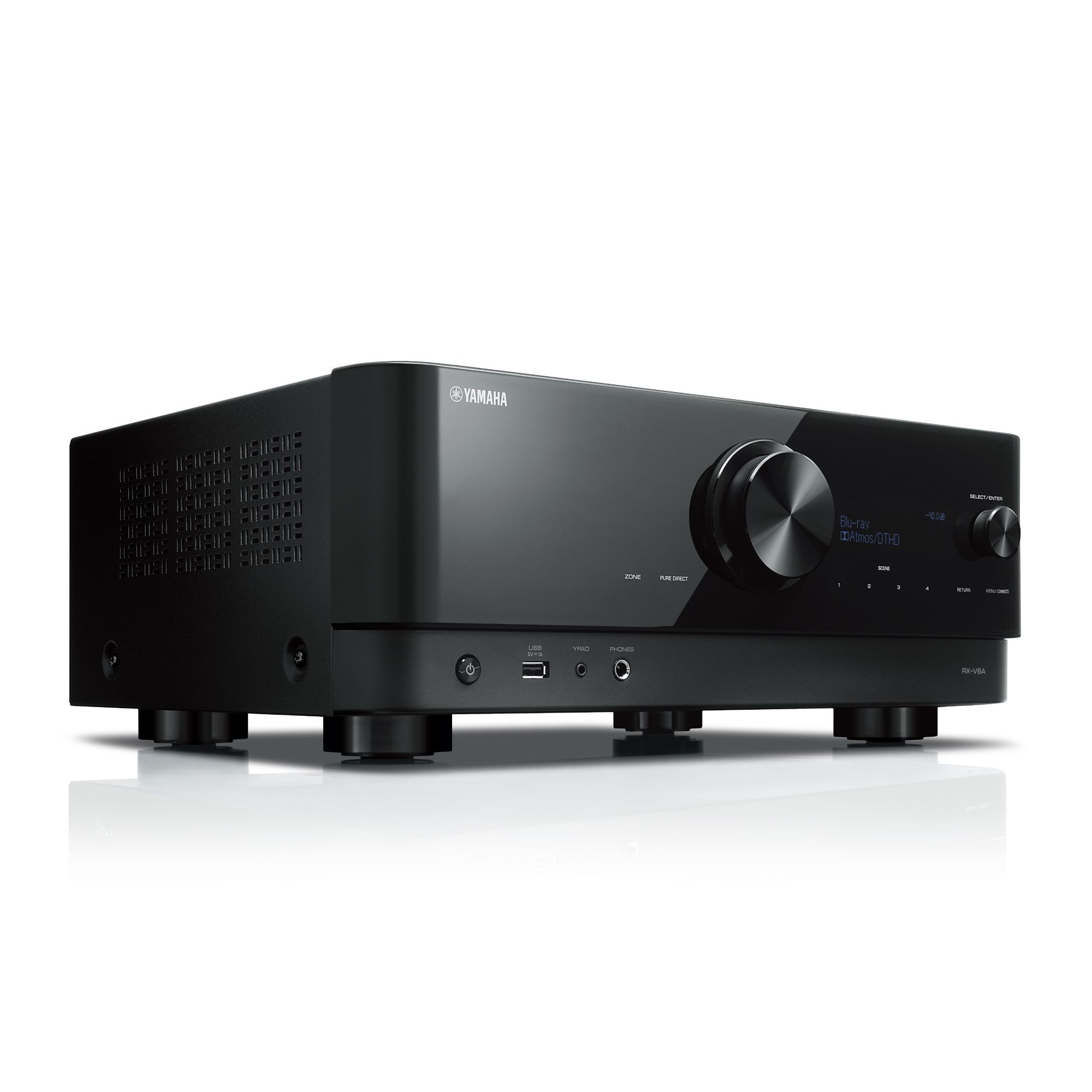
Buy the Yamaha RX-V6A if your speakers dip low — its curated rating covers 4Ω fronts where Sony's own sheet stops at 6Ω — and its power rating is the honest one. Buy the Sony STR-AN1000 for gaming connectivity: four stated HDMI 2.1 ports at 40 Gbps against the Yamaha's 24 Gbps ceiling.
As tracked by Home Theater Builder: the Sony STR-AN1000 tracks at $948; the Yamaha RX-V6A at $960.How we verify this data →
A 165-watt sticker against a 100-watt one, and the measurement contexts couldn't be further apart. This is the budget tier's cleanest lesson in why we store conditions with values.
Specifications · side by side · per-field provenance
● SOURCE-TRACKED
Spec
Sony STR-AN1000
Yamaha RX-V6A
Price
$948
$960
Brand
Sony
Yamaha
Channel configuration
7.2
7.2
Main channels
7
7
Subwoofer pre-outs
2
2
Zone 2 capable
Yes
Yes
Zone 3 capable
Yes
not stated
Watts per channel (6 Ω)
165
not stated
THD (%)
0.9
0.06
Channels driven (power rating)
one channel driven
two channels driven
Impedance range
6ohms-16ohms
Front: 4 Ω or more; Other: 6 Ω or more (default 8 Ω)
Speaker impedance, min (Ω)
6
4
Speaker impedance, max (Ω)
16
8
Dolby Atmos
Yes
Yes
DTS:X
Yes
Yes
IMAX Enhanced
Yes
not stated
Room correction system
Sony DCAC IX
YPAO
Measurement mic included
Yes
not stated
HDMI inputs
6
7
HDMI outputs
2
1
HDMI version
2.1
not stated
HDMI max bandwidth (Gbps)
40
24
HDMI 2.1 ports
4
not stated
HDMI eARC ports
1
1
Max passthrough resolution
8K 30
8K 60
HDR support
HDR10, Hybrid Log Gamma, Dolby Vision
HDR10, Dolby Vision, HLG
VRR passthrough
Yes
Yes
ALLM passthrough
Yes
Yes
Wi-Fi
Yes
Yes
Bluetooth
Yes
Yes
AirPlay 2
Yes
Yes
Streaming services
Spotify Connect
not stated
Form factor
full size
not stated
Width (in)
16.9
17.1
Height (in)
6.1
6.8
Depth (in)
13
14.9
Weight (lbs)
20.7
21.6
Power consumption (W)
240
not stated
Processing channels
not stated
7
Watts per channel (8 Ω)
not stated
100
Phono input
not stated
Yes
MusicCast
not stated
Yes
12 V trigger outputs
not stated
1
Shaded rows differ · green dot = lab-measured · amber = manufacturer-verified · blue = retailer/community-reported · grey = estimated · “not stated” means exactly that
Reading the numbers honestly
Sony's 165W is measured into 6Ω with ONE channel driven at 0.9% THD — the generous choice on all three axes. Yamaha's 100W is 8Ω, two channels driven, 0.06% THD — the strict one on all three. As printed the numbers cannot be ranked; corrected for context they are the same class of receiver. The spec that CAN be compared decides real pairings: Sony states a 6–16Ω speaker range while Yamaha's curated rating allows 4Ω front speakers — many popular bookshelves dip below 6Ω, and only one of these two is rated for that by its own sheet. Sony answers back on gaming I/O: four stated full-bandwidth HDMI 2.1 ports at a curated 40 Gbps vs Yamaha's curated 24 Gbps.
Compatibility · computed, not written
Checked against a bookshelf that dips to a stated 3.5Ω like the KEF LS50 Meta: KEF LS50 Meta
Can the Sony STR-AN1000 drive the KEF LS50 Meta?
Sony STR-AN1000 states a 6Ω-minimum rating, and the KEF LS50 Meta dips to a stated 3.5Ω minimum — well below that floor. By its own published spec this receiver is not rated for a load like this.
Can the Yamaha RX-V6A drive the KEF LS50 Meta?
Yamaha RX-V6A states a 4Ω-minimum rating; the KEF LS50 Meta dips to a stated 3.5Ω minimum, a little below that floor. Most receivers handle a marginal dip at normal volumes — it's worth watching only at very high output on an entry-level unit.
Computed from the catalog's normalized fields — the same fields the builder's compatibility engine reads. A missing field reads as "can't check", never as a pass.
Gaming & connectivity · answered from the spec sheets
Can the Sony STR-AN1000 and Yamaha RX-V6A pass 4K/120 through?
The Sony STR-AN1000 states 40 Gbps HDMI bandwidth — enough for full 4K/120; the Yamaha RX-V6A states 24 Gbps HDMI bandwidth, below the ~40 Gbps full 4K/120 needs.
The verdict
Buy the Yamaha RX-V6A if your speakers dip low — its curated rating covers 4Ω fronts where Sony's own sheet stops at 6Ω — and its power rating is the honest one. Buy the Sony STR-AN1000 for gaming connectivity: four stated HDMI 2.1 ports at 40 Gbps against the Yamaha's 24 Gbps ceiling.
Opposite rating philosophies on all three axes at once: 165W at 6Ω/ONE channel/0.9% THD (Sony) vs 100W at 8Ω/two channels/0.06% (Yamaha) — non-comparable as printed, and our context fields prove it.
Impedance floors point opposite ways: Sony states 6–16Ω (no 4Ω-class loads by its own sheet); Yamaha's curated rating allows 4Ω on the front pair.
Gaming I/O: Sony states 4 full-bandwidth HDMI 2.1 ports at a curated 40 Gbps; the Yamaha carries a curated 24 Gbps ceiling with no stated port count.