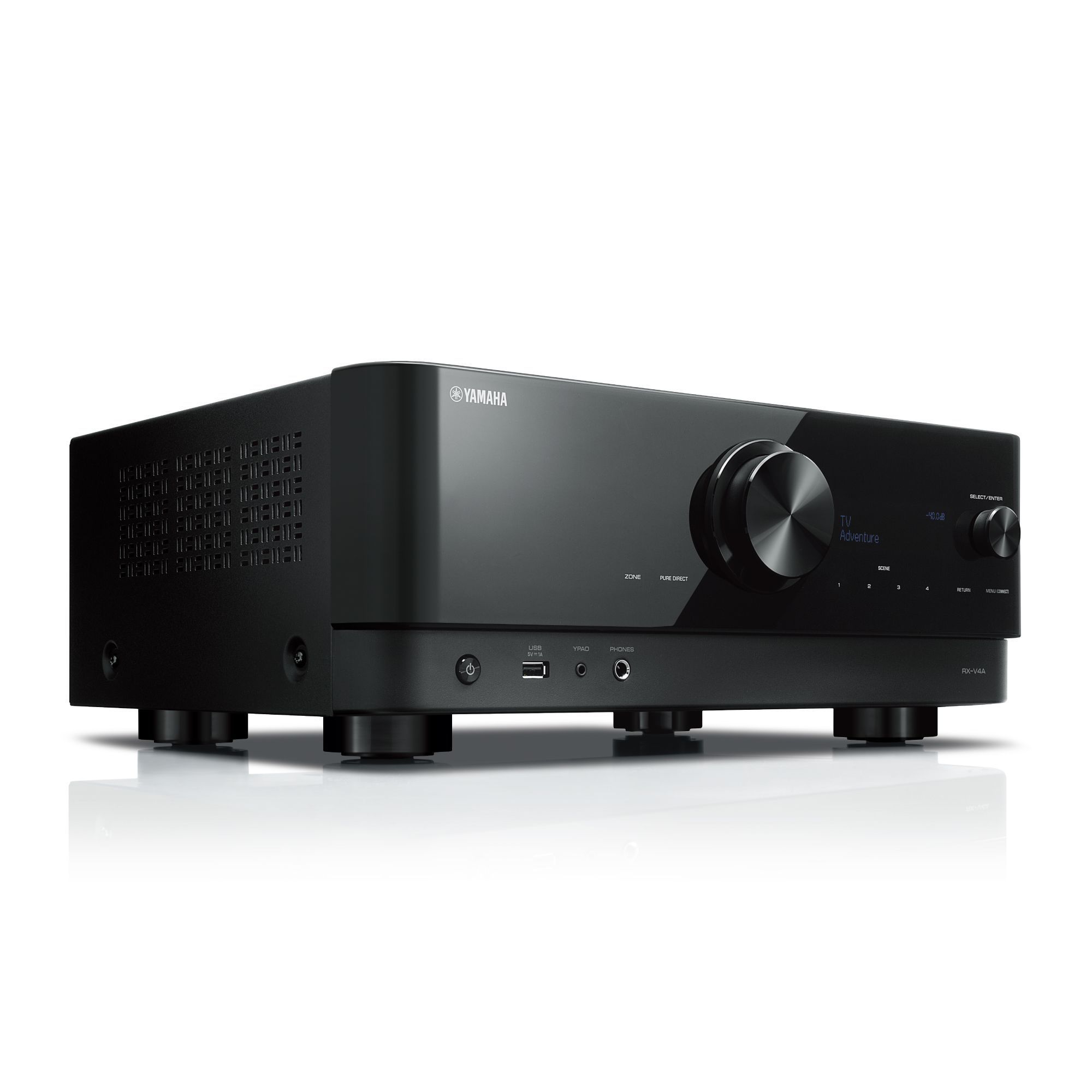
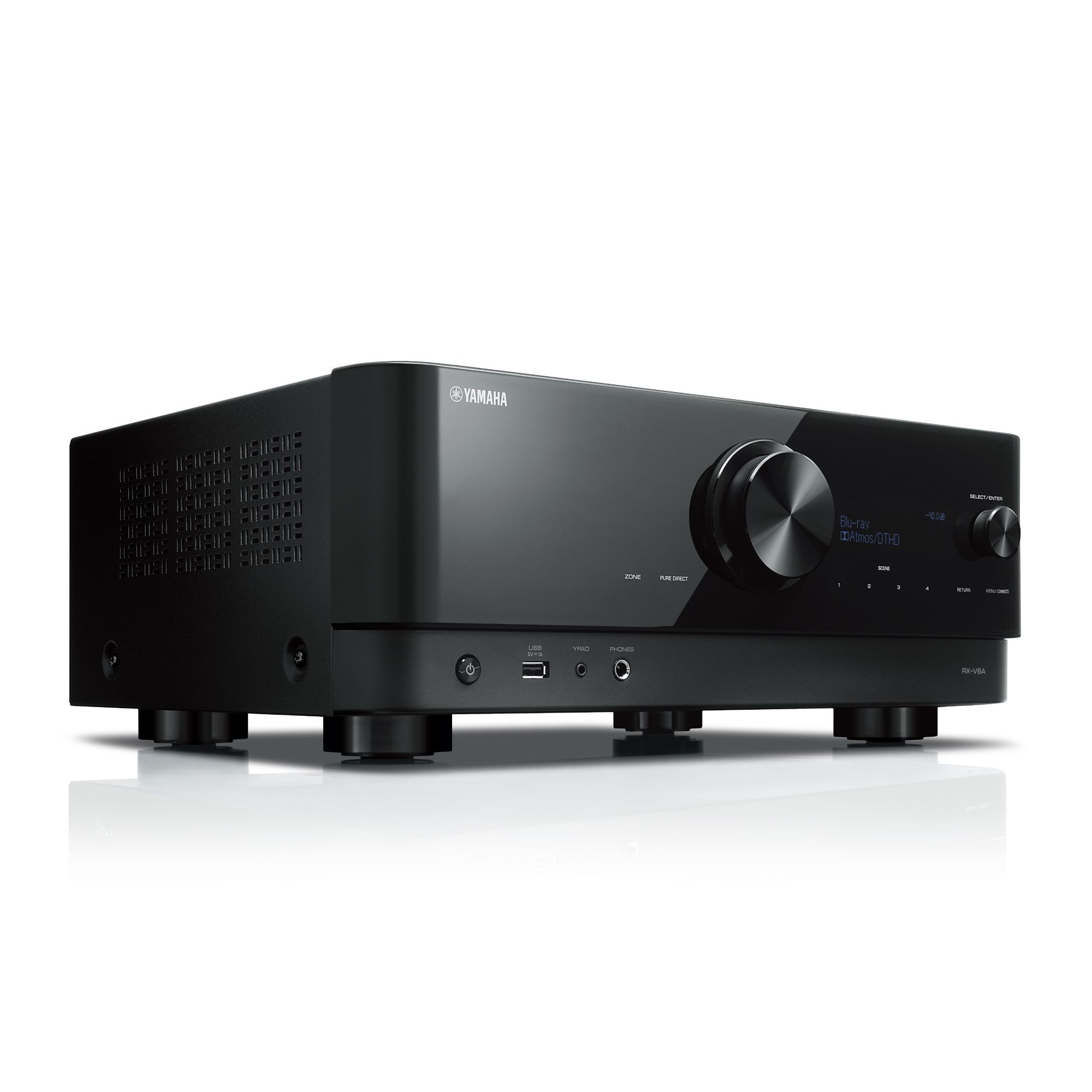
Buy the Yamaha RX-V6A if there's any chance you'll want Atmos, a phono input, or a second zone — every one of those is a stated FALSE on the RX-V4A's own sheet, not an omission. The V4A is only right when 5.1 (or stereo plus sub) is genuinely the end state.
As tracked by Home Theater Builder: the Yamaha RX-V4A tracks at $650; the Yamaha RX-V6A at $960.How we verify this data →
The most consequential ladder step in Yamaha's range, because it isn't about watts: the RX-V4A is a 5.2 receiver whose sheet states NO Atmos, and the RX-V6A is the 7.2 that adds it.
Specifications · side by side · per-field provenance
● SOURCE-TRACKED
Spec
Yamaha RX-V4A
Yamaha RX-V6A
Price
$650
$960
Brand
Yamaha
Yamaha
Channel configuration
5.2
7.2
Main channels
5
7
Processing channels
5
7
Subwoofer pre-outs
2
2
Zone 2 capable
No
Yes
Watts per channel (8 Ω)
80
100
Watts per channel (6 Ω)
80
not stated
THD (%)
0.06
0.06
Channels driven (power rating)
two channels driven
two channels driven
Impedance range
8 Ω (U.S.A./Canada; 6 Ω switchable)
Front: 4 Ω or more; Other: 6 Ω or more (default 8 Ω)
Speaker impedance, min (Ω)
6
4
Speaker impedance, max (Ω)
8
8
Dolby Atmos
No
Yes
DTS:X
No
Yes
Room correction system
YPAO
YPAO
HDMI inputs
4
7
HDMI outputs
1
1
HDMI version
2.1
not stated
HDMI max bandwidth (Gbps)
24
24
HDMI eARC ports
1
1
Max passthrough resolution
8K 60
8K 60
HDR support
HDR10, Dolby Vision, HLG, HDR10+
HDR10, Dolby Vision, HLG
VRR passthrough
Yes
Yes
ALLM passthrough
Yes
Yes
Phono input
No
Yes
Wi-Fi
Yes
Yes
Bluetooth
Yes
Yes
AirPlay 2
Yes
Yes
MusicCast
Yes
Yes
12 V trigger outputs
0
1
Width (in)
17.1
17.1
Height (in)
6.8
6.8
Depth (in)
14.9
14.9
Weight (lbs)
19.4
21.6
Shaded rows differ · green dot = lab-measured · amber = manufacturer-verified · blue = retailer/community-reported · grey = estimated · “not stated” means exactly that
Reading the numbers honestly
The RX-V4A states Dolby Atmos and DTS:X as FALSE — an honest, stated no, not a gap. The RX-V6A states both as TRUE with seven amplified channels to place real height speakers. Power is like-for-like within the house style: 80W vs 100W, both at 8Ω, two channels driven, 0.06% THD. The stated small print stacks the same way: the V4A states zone 2 = FALSE, phono = FALSE, and zero trigger outputs; the V6A states yes to all three. Both share Yamaha's stated 24 Gbps HDMI bandwidth ceiling in our curated data.
Compatibility · computed, not written
Checked against a bookshelf that dips to a stated 3.5Ω like the KEF LS50 Meta: KEF LS50 Meta
Can the Yamaha RX-V4A drive the KEF LS50 Meta?
Yamaha RX-V4A states a 6Ω-minimum rating, and the KEF LS50 Meta dips to a stated 3.5Ω minimum — well below that floor. By its own published spec this receiver is not rated for a load like this.
Can the Yamaha RX-V6A drive the KEF LS50 Meta?
Yamaha RX-V6A states a 4Ω-minimum rating; the KEF LS50 Meta dips to a stated 3.5Ω minimum, a little below that floor. Most receivers handle a marginal dip at normal volumes — it's worth watching only at very high output on an entry-level unit.
Computed from the catalog's normalized fields — the same fields the builder's compatibility engine reads. A missing field reads as "can't check", never as a pass.
Buy the Yamaha RX-V6A if there's any chance you'll want Atmos, a phono input, or a second zone — every one of those is a stated FALSE on the RX-V4A's own sheet, not an omission. The V4A is only right when 5.1 (or stereo plus sub) is genuinely the end state.
The RX-V4A's sheet states Dolby Atmos = FALSE, DTS:X = FALSE, zone 2 = FALSE, phono = FALSE, and 0 trigger outputs — five stated noes our three-state data records as facts, all of which the RX-V6A states as yes.
Like-for-like power: 80W vs 100W, both stated at 8Ω / two channels driven / 0.06% THD — about 1 dB.
Both share a stated 24 Gbps HDMI bandwidth in curated data — the step-up does NOT buy full 40 Gbps HDMI 2.1; neither is the pick for that.
5 vs 7 amplified channels and 5 vs 7 curated processing channels — the fork between 5.1-forever and a 5.1.2 Atmos layout.