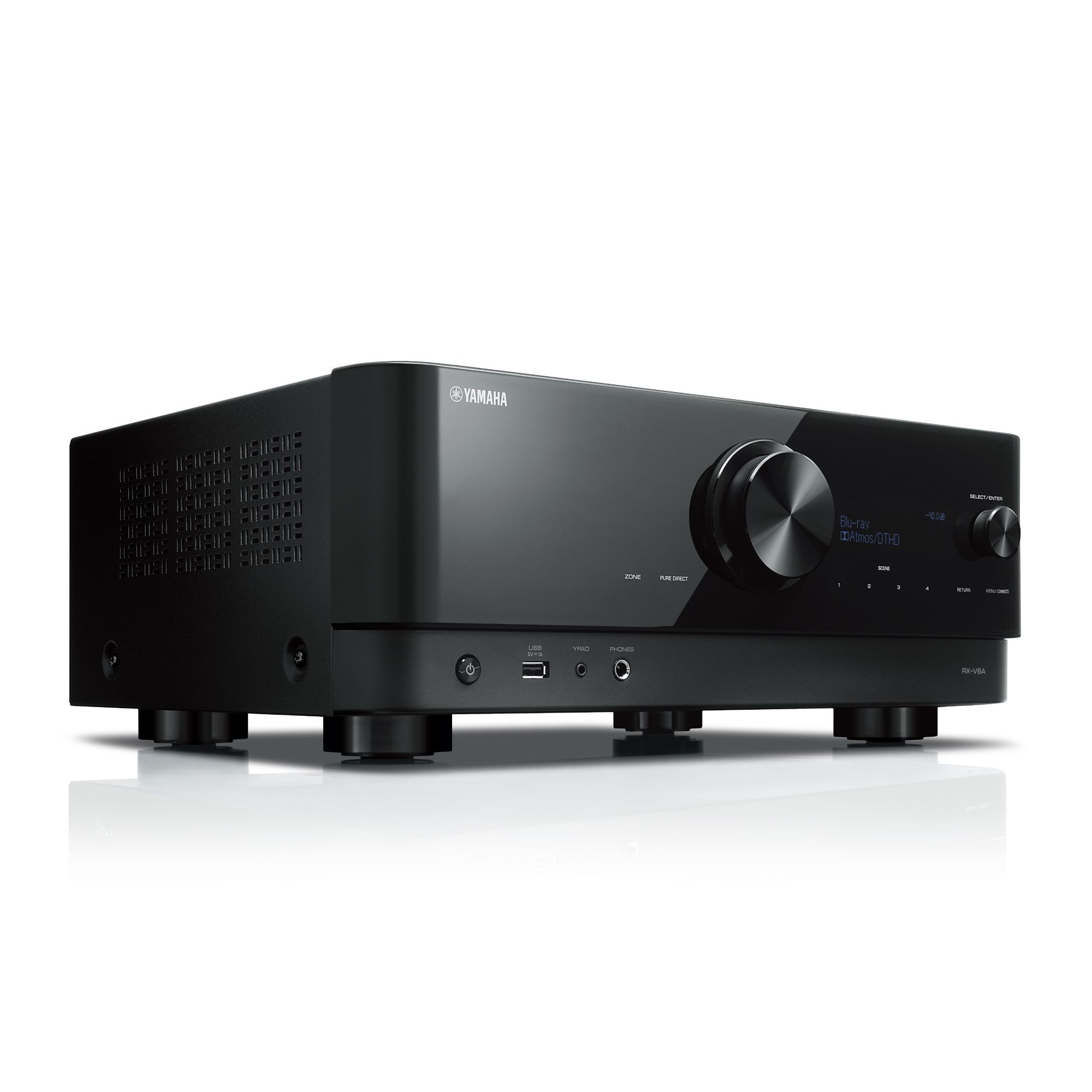
Buy the Yamaha RX-V6A for the amplifier — 100W at 0.06% THD beats 80W at 0.08% on both axes with the same 8Ω/2ch context. Buy the Onkyo TX-NR5100 if your speakers dip to 4Ω outside the front pair (its stated 4–16Ω rating is blanket) or if Sonos integration is stated-in rather than hoped-for.
As tracked by Home Theater Builder: the Onkyo TX-NR5100 tracks at $700; the Yamaha RX-V6A at $960.How we verify this data →
Two entry receivers that both rate their amplifiers the conservative way, which makes this one of the few budget comparisons you can read straight off the sheets.
Shaded rows differ · green dot = lab-measured · amber = manufacturer-verified · blue = retailer/community-reported · grey = estimated · “not stated” means exactly that
Reading the numbers honestly
Both figures are 8Ω, two channels driven: 80W at 0.08% THD (Onkyo, curated) vs 100W at 0.06% (Yamaha). The Yamaha's rating is higher AND measured stricter — a clean ~1 dB win with no context asterisk. Both are 7-channel Atmos designs with two sub pre-outs and seven curated processing channels. The Onkyo's counterpunch is disclosure: a stated blanket 4–16Ω impedance rating (the Yamaha allows 4Ω only on the fronts per curated data), stated Works-with-Sonos and Roon Tested certifications, and DTS Play-Fi in its stated streaming list. Both carry a curated 24 Gbps HDMI bandwidth — neither is the full-fat HDMI 2.1 pick.
Compatibility · computed, not written
Checked against a bookshelf that dips to a stated 3.5Ω like the KEF LS50 Meta: KEF LS50 Meta
Can the Onkyo TX-NR5100 drive the KEF LS50 Meta?
Onkyo TX-NR5100 states a 4Ω-minimum rating; the KEF LS50 Meta dips to a stated 3.5Ω minimum, a little below that floor. Most receivers handle a marginal dip at normal volumes — it's worth watching only at very high output on an entry-level unit.
Can the Yamaha RX-V6A drive the KEF LS50 Meta?
Yamaha RX-V6A states a 4Ω-minimum rating; the KEF LS50 Meta dips to a stated 3.5Ω minimum, a little below that floor. Most receivers handle a marginal dip at normal volumes — it's worth watching only at very high output on an entry-level unit.
Computed from the catalog's normalized fields — the same fields the builder's compatibility engine reads. A missing field reads as "can't check", never as a pass.
Buy the Yamaha RX-V6A for the amplifier — 100W at 0.06% THD beats 80W at 0.08% on both axes with the same 8Ω/2ch context. Buy the Onkyo TX-NR5100 if your speakers dip to 4Ω outside the front pair (its stated 4–16Ω rating is blanket) or if Sonos integration is stated-in rather than hoped-for.
A rare both-sides-honest budget comparison: 80W/0.08% (curated) vs 100W/0.06%, both at 8Ω with two channels driven — the Yamaha wins on value and test severity at once.
Impedance disclosure differs in structure: Onkyo states a blanket 4–16Ω range; Yamaha's curated rating restricts 4Ω to the front channels.
Both carry a curated 24 Gbps HDMI bandwidth — the entry tier's shared ceiling, stated rather than assumed.
The Onkyo states Works-with-Sonos and Roon Tested certifications and DTS Play-Fi streaming; none of the three appears on the Yamaha's sheet in our data.