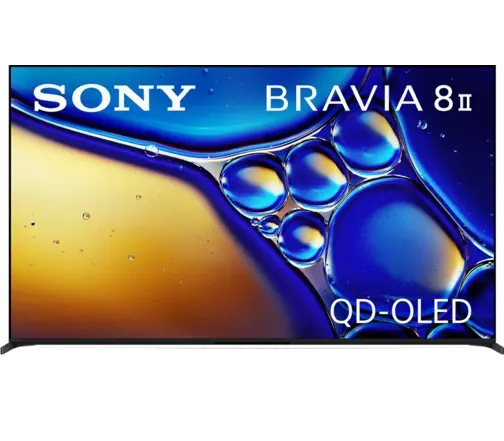
On every gaming and HDR field both rows record, these two match: 4K/120, VRR, ALLM, HDR10, Dolby Vision and AirPlay 2, all manufacturer-stated. The choice comes down to the panel and the platform — Sony's QD-OLED and Google TV, or LG's OLED evo and webOS — and this page will not rank the panels, because neither row records a measured brightness, contrast or colour figure. If you need to plan the install from a spec sheet, the OLED65C5 is the one our rows cover: 56.7 × 32.5 × 1.8 inches, 36.6 lb, a 300 × 200 mm VESA pattern, four HDMI inputs with eARC and Dolby Atmos, all from LG's C5 sheet, where our Sony row records none of those fields — a gap in our data, not a missing feature.
As tracked by Home Theater Builder: the Sony K65XR80M2 tracks at $3,000; the LG OLED65C5PUA at $1,350.How we verify this data →
Sony's Bravia 8 II (K65XR80M2) and LG's OLED65C5 are both 65-inch OLEDs, and on the gaming and HDR features our rows record they read the same. Both rows state 4K at 120 Hz for gaming, VRR, ALLM, HDR10, Dolby Vision and AirPlay 2. The real differences are the panel each one is built on, the platform it runs, and how much of the install our two rows let you plan.
Specifications · side by side · per-field provenance
● SOURCE-TRACKED
Spec
Sony K65XR80M2
LG OLED65C5PUA
Price
$3,000
$1,350
Brand
Sony
LG
Screen size (in)
65
65.1
Panel type
QD-OLED
OLED evo
Native resolution
4K UHD
4K UHD
HDR10
Yes
Yes
Dolby Vision
Yes
Yes
Max gaming spec
4K 120
4K 120
VRR support
Yes
Yes
ALLM
Yes
Yes
Operating system
Google TV
webOS
AirPlay 2
Yes
Yes
Native refresh rate (Hz)
not stated
120
Filmmaker Mode
not stated
Yes
HDMI max bandwidth (Gbps)
not stated
48
HDMI total ports
not stated
4
eARC port
not stated
Yes
VRR types
not stated
GSync Compatible, FreeSync
Dolby Atmos output
not stated
Yes
USB ports
not stated
3
Wi-Fi
not stated
Yes
Width, no stand (in)
not stated
56.7
Height, no stand (in)
not stated
32.5
Depth, no stand (in)
not stated
1.8
Weight, no stand (lbs)
not stated
36.6
VESA pattern (mm)
not stated
300 x 200
Shaded rows differ · green dot = lab-measured · amber = manufacturer-verified · blue = retailer/community-reported · grey = estimated · “not stated” means exactly that
Reading the numbers honestly
Every field cited on this page is manufacturer-stated: the Sony's ten fields come from Sony's product page and the LG's from LG's C5 spec sheet (the one LG field we hold from a retailer, its HDMI bandwidth, is not used here). The two rows overlap on 4K UHD resolution, 4K/120 gaming, VRR, ALLM, HDR10, Dolby Vision and AirPlay 2 — a match on all seven. They differ on panel type, QD-OLED on the Sony against OLED evo on the LG, and on platform, Google TV against webOS. Screen size is written two ways: a 65-inch class on the Sony against a 65.1-inch diagonal on the LG. The LG row records thirteen fields the Sony row does not: a native 120 Hz refresh (VRR up to 144 Hz), Filmmaker Mode, G-Sync Compatible and FreeSync, four HDMI inputs, eARC, Dolby Atmos, three USB ports, Wi-Fi, and a 56.7 × 32.5 × 1.8-inch body at 36.6 lb with a 300 × 200 mm VESA pattern. Those are blanks on our Sony row, not Sony noes. Neither row records a peak-brightness or measured picture figure, so panel type is reported and never ranked.
Compatibility · computed, not written
Checked as the display leg behind a popular budget receiver, the Denon AVR-X1800H: Denon AVR-X1800H
Does the Sony K65XR80M2 keep VRR through a receiver like the Denon AVR-X1800H?
Sony K65XR80M2 supports VRR and the Denon AVR-X1800H passes VRR through — the variable-refresh chain holds with a console wired through the receiver.
Does the LG OLED65C5PUA keep VRR through a receiver like the Denon AVR-X1800H?
LG OLED65C5PUA supports VRR and the Denon AVR-X1800H passes VRR through — the variable-refresh chain holds with a console wired through the receiver.
Computed from the catalog's normalized fields — the same fields the builder's compatibility engine reads. A missing field reads as "can't check", never as a pass.
On every gaming and HDR field both rows record, these two match: 4K/120, VRR, ALLM, HDR10, Dolby Vision and AirPlay 2, all manufacturer-stated. The choice comes down to the panel and the platform — Sony's QD-OLED and Google TV, or LG's OLED evo and webOS — and this page will not rank the panels, because neither row records a measured brightness, contrast or colour figure. If you need to plan the install from a spec sheet, the OLED65C5 is the one our rows cover: 56.7 × 32.5 × 1.8 inches, 36.6 lb, a 300 × 200 mm VESA pattern, four HDMI inputs with eARC and Dolby Atmos, all from LG's C5 sheet, where our Sony row records none of those fields — a gap in our data, not a missing feature.
4K/120 console gamingEither — Both rows state 4K/120, VRR and ALLM, manufacturer-stated on each side.
HDR formatsEither — HDR10 and Dolby Vision are manufacturer-stated on both rows.
Panel typeEither — QD-OLED on the Sony against OLED evo on the LG, both manufacturer-stated — reported, not ranked, since neither row records a measured picture figure.
Google TV or webOSEither — Google TV on the Sony, webOS on the LG — a platform preference, not a spec win. Both state AirPlay 2.
Planning a wall mountLG OLED65C5PUA — 56.7 × 32.5 × 1.8 inches, 36.6 lb and a 300 × 200 mm VESA pattern from LG's C5 sheet; our Sony row records no dimensions, weight or VESA pattern.
Wiring a soundbar or receiverLG OLED65C5PUA — Four HDMI inputs, eARC and Dolby Atmos are manufacturer-stated on the LG; our Sony row records no port, eARC or audio field.
Both rows state 4K/120 gaming, VRR, ALLM, HDR10, Dolby Vision and AirPlay 2 — manufacturer-stated on each side, a match on all six.
The panels differ by type: QD-OLED on the Sony against OLED evo on the LG, both manufacturer-stated; neither row records a measured picture figure, so the types are reported and never ranked.
The LG's C5 sheet states a native 120 Hz refresh with VRR up to 144 Hz; our Sony row records 4K/120 gaming but no native refresh-rate field.
Only the LG row lets you plan a mount: 56.7 × 32.5 × 1.8 inches, 36.6 lb and a 300 × 200 mm VESA pattern, against no dimensions, weight or VESA pattern on our Sony row.
Four HDMI inputs, eARC and Dolby Atmos are manufacturer-stated on the LG and not on file for the Sony — a blank on our row, not a Sony no.
Screen size is written two ways: a 65-inch class on Sony's page against a 65.1-inch diagonal on LG's sheet.