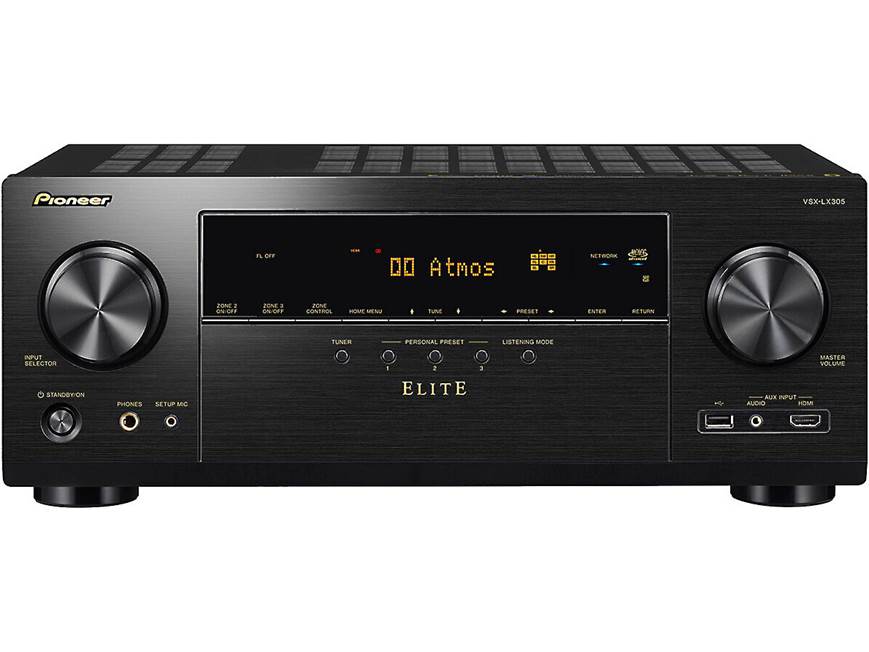
Buy the Onkyo TX-RZ50 — its power rating is the honest one, it states the 4–16Ω impedance rating the Pioneer's sheet lacks, and it processes eleven channels to the LX305's curated nine, all on the same Dirac Live foundation. The LX305's bigger sticker was earned one channel at a time at ten times the distortion.
Onkyo and Pioneer receivers now come from the same company, which makes this pair a controlled experiment in spec-sheet philosophy: two nine-channel Dirac Live receivers whose power numbers were produced under nearly opposite conditions.
Shaded rows differ · green dot = lab-measured · amber = manufacturer-verified · blue = retailer/community-reported · grey = estimated · “not stated” means exactly that
Reading the numbers honestly
The RZ50 leads with the conservative line: 120W at 8Ω, two channels driven, 0.08% THD. The LX305's curated figure is 170W at 8Ω — with ONE channel driven at 1% THD, the generous test on both axes. As printed, 170 vs 120 cannot be ranked, and we won't pretend otherwise; corrected for conditions these are close amplifier classes. Both carry Dirac Live (the LX305 stated full-bandwidth). The RZ50 states a 4–16Ω impedance rating and eleven processing channels; the LX305's impedance range is unstated in our data and its curated processing count is nine.
Compatibility · computed, not written
Checked against a bookshelf that dips to a stated 3.5Ω like the KEF LS50 Meta: KEF LS50 Meta
Can the Onkyo TX-RZ50 drive the KEF LS50 Meta?
Onkyo TX-RZ50 states a 4Ω-minimum rating; the KEF LS50 Meta dips to a stated 3.5Ω minimum, a little below that floor. Most receivers handle a marginal dip at normal volumes — it's worth watching only at very high output on an entry-level unit.
Can the Pioneer VSX-LX305 drive the KEF LS50 Meta?
Pioneer VSX-LX305 publishes no rated impedance range, so the pairing with the KEF LS50 Meta (which dips to a stated 3.5Ω minimum) can't be verified from its spec sheet — we treat that as "can't check", not a pass.
Computed from the catalog's normalized fields — the same fields the builder's compatibility engine reads. A missing field reads as "can't check", never as a pass.
Buy the Onkyo TX-RZ50 — its power rating is the honest one, it states the 4–16Ω impedance rating the Pioneer's sheet lacks, and it processes eleven channels to the LX305's curated nine, all on the same Dirac Live foundation. The LX305's bigger sticker was earned one channel at a time at ten times the distortion.
Trustworthy amplifier specOnkyo TX-RZ50 — 120W at 8Ω/2ch/0.08% vs 170W at 8Ω/1ch/1% — the smaller number is the harder test.
Low-impedance speakersOnkyo TX-RZ50 — A stated 4–16Ω rating; the Pioneer publishes no impedance range in our data.
Committed Pioneer householdsPioneer VSX-LX305 — Same Dirac Live full-bandwidth correction and nine amplified channels — the platform fundamentals genuinely match.
Where to buy
CHEAPEST FIRST · NOT COMMISSION-RANKED
Onkyo TX-RZ50
Tracked at Adorama · price not quotable from a search page
A same-company rating-philosophy split our context fields expose: 120W (8Ω/2ch/0.08% THD) vs a curated 170W (8Ω/ONE channel/1% THD) — different tests on two axes, flagged as non-comparable as printed.
The RZ50 states a 4–16Ω impedance rating; the LX305's range is unstated in our data.
Both are nine-channel Dirac Live receivers with zone 3 — the correction and topology parity is real; processing channels differ 11 vs a curated 9.