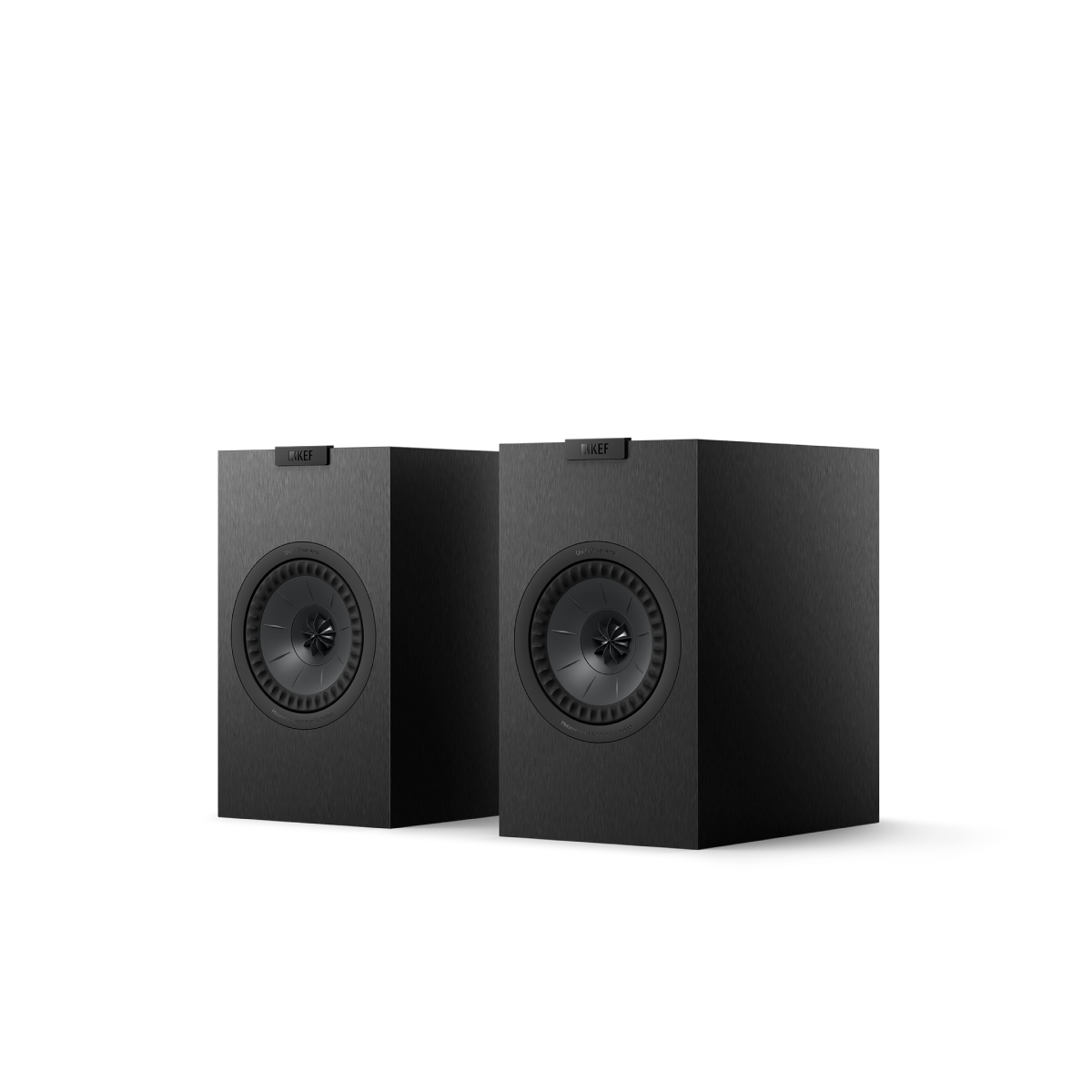
← Compare toolSpeakers · Head to head
KEF Q150 vs KEF LS50 Meta
KEF's entry coaxial vs its icon — which should you buy?
Same brand, same coaxial Uni-Q idea, very different ambition. The Q150 is the budget classic; the LS50 Meta is the small-room royalty. The electrical fine print matters more than the family resemblance.
Reading the numbers honestly
Both are '8Ω nominal' on the box — and both state minimums in 4Ω-class territory: 3.7Ω (Q150) and 3.5Ω (LS50 Meta). For amplifier matching they are low-impedance speakers, whatever the nominal says. Sensitivity is 86 vs 85 dB with the measurement context UNSTATED for both. And a pricing-unit note: the Q150's tracked $399.99 is stated per pair; the LS50 Meta's listing does not state its sale unit, so our catalog prices it under the per-single assumption — a gap we flag rather than hide.
Specifications · side by side · per-field provenance● SOURCE-TRACKED
| Spec | KEF Q150 | KEF LS50 Meta |
|---|
| Price | $400 /pair | $1,800 /pair |
| Brand | KEF | KEF |
| Speaker Type | bookshelf standmount | bookshelf standmount |
| Way Config | coaxial 2way | 2-way |
| Woofer Count | 1 | 1 |
| Woofer Size Inches | 5.25 | 5.25 |
| Tweeter Type | aluminum dome | aluminum dome |
| Tweeter Size Inches | 1 | 1 |
| Impedance Nominal Ohms | 8 | 8 |
| Impedance Minimum Ohms | 3.7 | 3.5 |
| Sensitivity DB 1w1m | 86 | 85 |
| Sensitivity Measurement Context | unstated | unstated |
| Freq Response Low HZ | 51 | 79 |
| Freq Response High HZ | 28000 | 28000 |
| Freq Response Tolerance | unstated | plus minus 3dB |
| Crossover Frequency HZ | 2500 | 2100 |
| Enclosure Type | bass reflex ported | bass reflex ported |
| Height Inches | 11.9 | 11.9 |
| Width Inches | 7.1 | 7.9 |
| Depth Inches | 10.9 | 11 |
| Weight Lbs | 12.3 | 17.2 |
| Sold As | pair | not stated |
| Recommended Power Min W | not stated | 40 |
| Recommended Power Max W | not stated | 100 |
| Finish Options | not stated | Carbon Black, Titanium Grey, Mineral White, Royal Blue |
Shaded rows differ · green dot = lab-measured · amber = manufacturer-verified · blue = retailer/community-reported · grey = estimated · “not stated” means exactly that
Compatibility · computed, not written
Checked against a popular budget receiver, the Denon AVR-X1800H (80W per channel into 8Ω): Denon AVR-X1800H
KEF Q150 dips to a stated 3.7Ω minimum; the Denon AVR-X1800H publishes no rated impedance range, so this pairing reads as "can't check" from the sheets alone.
KEF LS50 Meta dips to a stated 3.5Ω minimum; the Denon AVR-X1800H publishes no rated impedance range, so this pairing reads as "can't check" from the sheets alone.
Computed from the catalog's normalized fields — the same fields the builder's compatibility engine reads. A missing field reads as "can't check", never as a pass.
Check either one against your own build →The verdict
Buy the KEF Q150 for the money — it's the same coaxial concept with a stated pair price of $399.99 and a deeper 51 Hz spec floor. Buy the LS50 Meta when the budget genuinely stretches: its 79 Hz floor assumes a subwoofer, and KEF itself recommends 40–100W of amplification.
First serious small-room pairKEF Q150 — Same point-source imaging idea, quarter-ish of the outlay, and a stated pair price.
End-game bookshelf with a subKEF LS50 Meta — The LS50 Meta is spec'd to only 79 Hz (±3 dB) — it's designed around a subwoofer, and executes the coaxial idea at a higher level.
Modest receiver, no subKEF Q150 — 51 Hz vs 79 Hz stated floors; both dip below 4Ω, so neither is a free lunch for a budget receiver.
What our normalized data addsNOT ON THE SPEC SHEETS
- Both are 8Ω nominal on paper, but the normalized minimums — 3.7Ω and 3.5Ω stated — put BOTH in 4Ω-class territory for amp matching; the nominal figure alone would mislead.
- Sensitivity 86 vs 85 dB with measurement context UNSTATED on both — we record that gap instead of treating the numbers as lab-comparable.
- Stated bass floors 51 Hz vs 79 Hz — the pricier speaker reaches HIGHER, by design (it assumes a subwoofer; KEF recommends 40–100W).
- Pricing-unit honesty: the Q150's $399.99 is stated per pair (sold_as pair); the LS50 Meta's sale unit is unstated in our data, so its displayed pair price rests on a per-single assumption we disclose.
Not the exact matchup you wanted?